

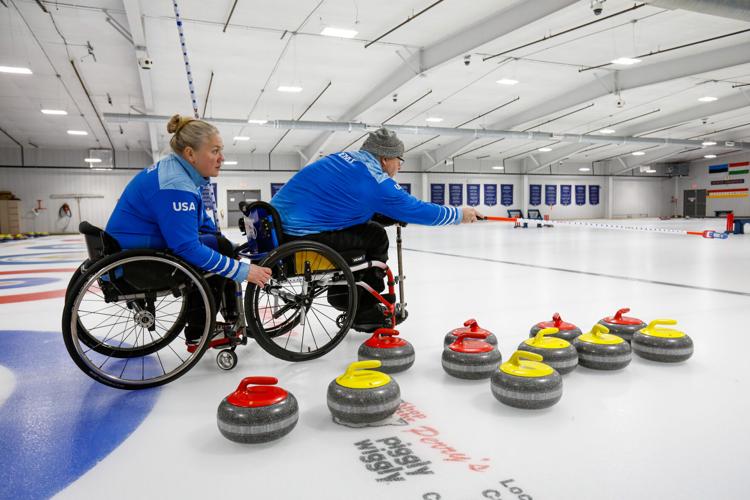
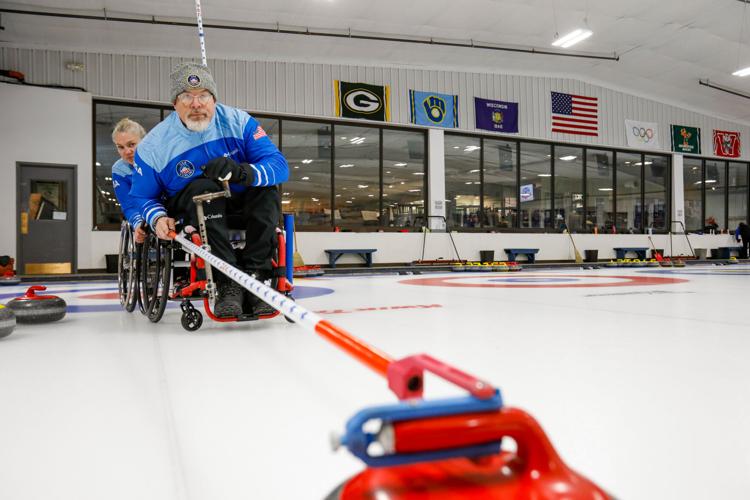

Paralympic curlers Steve Emt and Laura Dwyer time every one of their throws.
Timing them, Dwyer said, gives the team a sense of speed as they try to precisely steer large, 40-something pound granite stones over a large sheet of ice toward four concentric circles.
Emt and Dwyer, teammates for two years, are preparing to represent the United States in wheelchair curling at the Paralympic Games. As they throw, they yell numbers to indicate the weight — where they want the stone to land. Between calls, they yell words of encouragement, occasionally challenging one another.
“Some people might listen to us ... and be like, ‘Damn, you guys are tough on each other,’ Emt said. “And we are.”
That directness comes from their goal. “Gold medal. Without question, a gold medal. That's our expectation,” Emt said.
Madison will send seven competing athletes to the 2026 Winter Olympic and Paralympic Games in Milan and Cortina d'Ampezzo, Italy (styled as Milan Cortina 2026).
The Olympic Games will start Feb. 4, with opening ceremonies on Feb. 6, and run through Feb. 22. The Paralympic Games will be held March 6-15. The Games will be broadcast on NBC and streamed on Peacock.
Even before the Games start, participating athletes are making history. Emt and Dwyer will compete in the first wheelchair curling mixed doubles event the Games have hosted. This will be Emt’s third Paralympic Games, the most any wheelchair curler has ever competed in.
The University of Wisconsin-Madison will send five current players from the women's hockey team and seven past players, the most the school has ever sent to a single Olympics (UW-Madison sent 11 players to the 2022 Games in Beijing). Four of the current players will suit up for Team USA; one, freshman Adéla Šapovalivová, will play for Team Czechia.
Madison has a long history of sending athletes to the Winter Games, particularly in ice sports, thanks to the area's easy access to ice on the lakes. But Madison athletes have also influenced the Games themselves by drawing attention to certain sports, propelling them back into the Games and into the public eye.
“The idea of winter sport competitions goes back to before the Civil War in Wisconsin,” said Leo Landis, director of public history for the Wisconsin Historical Society.
The Historical Society has installed a display at the Capitol that honors Wisconsin’s winter sport history, including photos and memorabilia from past Olympians. The display will be up through June.

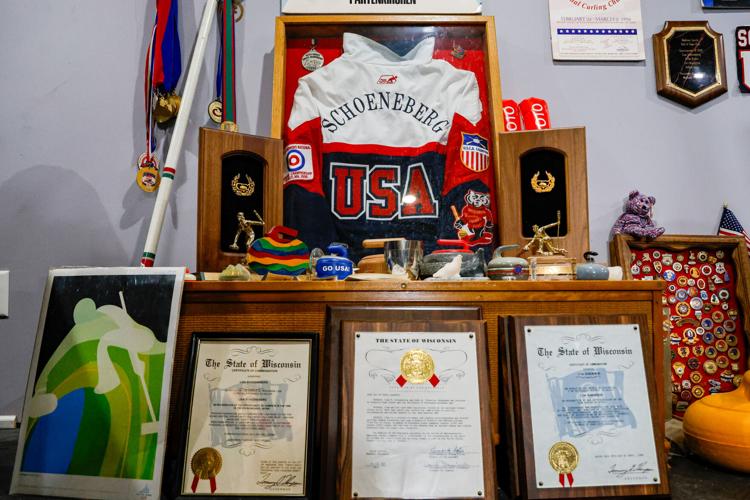
Lisa Schoeneberg was part of the 1988 U.S. women's curling team and is credited with helping bring curling back into the Olympic Games as a medal sport. She's saved many of her accolades and memorabilia from her career as a curler.
Bringing back curling to the Olympics
Curling has a deep history in Madison and Wisconsin broadly. The sport came to North America with Scottish immigrants, and the Milwaukee Curling Club, established in 1845, is the nation's longest continuously running club (Wisconsin was admitted as a state in 1848).
Curling is often called “chess on ice” because it’s highly strategic, requiring teams facing each other head-to-head to strategize about placement of the stone (the rock players slide across the ice).
Teams throw their stones toward the “house,” four concentric circles, trying to get each stone as close to the button (the center circle) as possible. Teams play either eight or 10 rounds (called ends) per game.
Strategy play can get even more intense in wheelchair curling because there are no sweepers, or teammates who follow the stone and sweep the ice to help direct its course.
“I’m aiming for a spot about the size of a basketball, 120 feet away on the ice,” Emt said. “It’s more strategy, because we have to do a better job of placing stones in different places in the house.”
Curling was part of the first Winter Games in 1924 in Chamonix, France, but wouldn’t be recognized as a medal sport until the 1998 Nagano Games in Japan. Wheelchair curling became an Olympic sport in 2006.
The game was played as a demonstration sport (an event added to generate interest that may later be officially entered as a medal sport) in the 1932 Games in Lake Placid, was absent for almost 50 years, then again as a demonstration sport in 1988 during the Calgary Games. The U.S. women’s curling team that year included three members from the Madison Curling Club.
Lisa Schoeneberg was a member of the 1988 squad and the team’s skip. The skip is responsible for setting strategy, and teams are often referred to by the name of the skip (in this case, Team Schoeneberg).
“Steve Brown (a decorated Wisconsin curler) approached me,” Schoeneberg said. “His daughter played with us, who was 14 at the time. He said, ‘You're a pretty good curler. Let’s see what we can do.’ So we got a couple of other players and got at it.”
Before going to Canada, the team had to qualify for the Olympics. The four-person team, which was coached by Brown, included his daughter Erika and Lori Mountford, both of whom played at the Madison Curling Club. The fourth, Carla Casper, curled in Green Bay.
The team upset the defending national champions to win the Olympic trials in St. Paul. “I don't think anybody thought we would win,” said Schoeneberg, who was 33 at the time.
In Calgary, she remembered being part of the opening ceremonies, realizing she was representing her country.
“They give you a little flag, and you're like, ‘Holy god,’” she said.
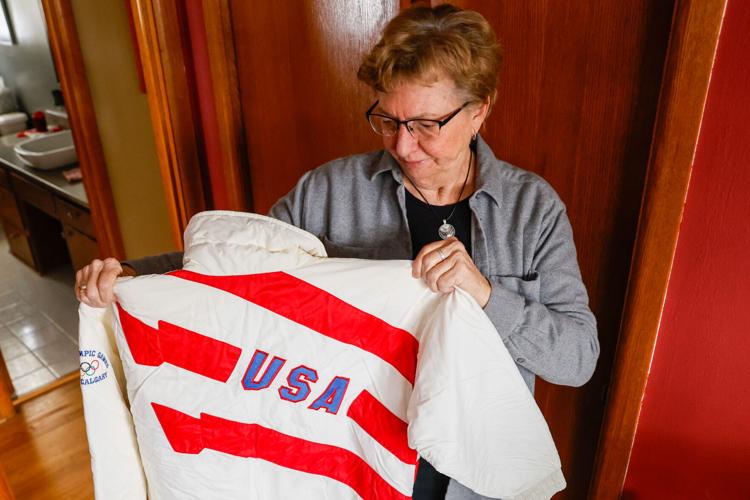
Schoeneberg, who lives in Monona, has a basement full of memorabilia, including pictures, plaques and pins from the Games (trading pins is a big Olympic tradition among athletes). She still has the sweats emblazoned with “Team USA” from the ’88 Games.
The team placed fifth in Calgary and Schoeneberg went to the Olympics again in 1998. There, the team also placed fifth.
The ’88 curlers are often credited with shining a light on the sport and bringing it back to the Olympics.
“We had to perform well, we had to make it look good, so it’d be a full medal sport,” Schoeneberg said.

Lisa Schoeneberg still has the sweatsuit given to the athletes from the 1988 U.S. women’s curling team. She remembed walking with Team USA during the opening ceremonies in Calgary: “They give you a little flag, and you're like, ‘Holy god,’” she said.
Line up the stone
The Madison Curling Club has sent many of its members to the Games, including family dynasties like the Browns.
In addition to coaching the 1988 and 1998 women's teams, Steve Brown was the longtime coach of the wheelchair curling team. Erika Brown competed in the 2014 Sochi Games while her brother, Craig, was an alternate on the men’s team the same year.
At the 2018 Games in Pyeongchang, South Korea, the men’s four-person curling team won the Americans’ first gold in curling. On the team was Matt Hamilton, who lives in McFarland and was part of the Madison Curling Club.
Hamilton competed in mixed doubles the same year with his sister, Becca, who was also on the women's Olympic curling team. Becca competed again in the 2022 Games in Beijing.
Wheelchair curling mixed doubles is new to the Paralympics, but Emt was on the four-person team that finished 12th in 2018 and jumped to fifth in 2022.
Now, Emt and Dwyer are the reigning U.S. national champions, and their trip to the Olympic trials in Sioux Falls was thrilling. The duo went up against Penny Ricker and David Samsa and blew them out 9-1 in the first game. In the second game, Emt and Dwyer were ahead, but Ricker and Samsa surged to tie it, sending the match to an extra set.
In a YouTube clip of the game, Emt and Dwyer can be heard debating the best strategy to throw their last stone. Dwyer, who is throwing the stone, eventually lands on Emt’s strategy and readies herself by saying, “Line me up.” Her throw won them the game and the duo’s spot in the Paralympics.
“It brings tears to my eyes,” to recount this moment, Dwyer said. Her telling Emt to line it up was “me saying, ‘I'm buying in. Let's go. I believe you. I will do what you tell me and what I do will work.’”
“She and I are cut from the same cloth,” said Emt. “We should have been twins.”

Laura Dwyer, left, steadies wheelchair curling partner Steve Emt as he throws a stone during a practice game. Emt and Dwyer will represent the United States at the premiere of mixed doubles wheelchair curling at the 2026 Paralympic Games.
‘Do you believe in miracles?’
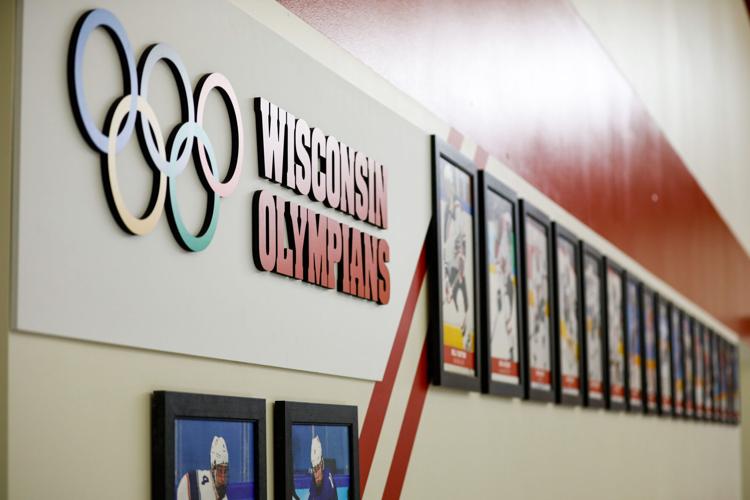
The UW-Madison women’s hockey program has produced 25 Olympians. A wall in UW-Madison’s LaBahn Arena, where the team plays and practices, is dedicated to past Badger Olympians like Hilary Knight, who has played on Team USA since 2010 and has one gold and three silver medals. Knight told ESPN that while she’s not retiring yet, Milan Cortina 2026 will be her last Olympics.
In a press conference in early January, Caroline Harvey, one of the four current Badgers who will compete in Italy, credited UW-Madison’s Olympic hockey legacy to coach Mark Johnson.
“He’s a legend himself in his playing career,” she said. “(The way he) develops players ... he lets our team steer the boat in a way. He has full trust in us.”
Johnson, along with fellow Badger Bob Suter, was part of the 1980 U.S. men's hockey team — perhaps the single greatest story to come out of the Winter Olympics. Made up primarily of amateur and collegiate players, the team beat the four-time Olympic champion Soviet Union in one of the most unlikely upsets in sports history.
This game, played at the height of the Cold War, is known as the “Miracle on Ice.” The phrase “Do you believe in miracles?” is part of the cultural lexicon, drawn from a call that announcer Al Michaels made as the clock wound down.

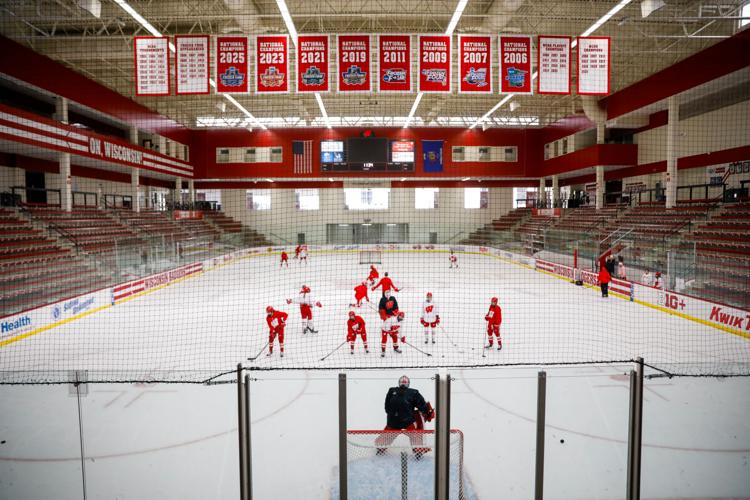
The women’s hockey team at UW-Madison will send five current players to the 2026 Olympic Games in Milan Cortina. Four will play for Team USA; one, freshman Adéla Šapovalivová, will play for Team Czechia.
Johnson started coaching the Badgers women's hockey team in 2002. Since then, the program has won eight national championships. This year's team is 24-2-2.
Along with Harvey, current players competing for Team USA include goalie Ava McNaughton and forwards Laila Edwards and Kristen Simms. Team Canada has five former Badgers on its team.
Simms described the moment she found out she was going to the Olympics as “like saying that you want to be an astronaut someday, and then when you get older, you realize the dream could possibly become true. And then it really does.”
This will be Simms’ first Olympics. The UW-Madison coaching staff helped her polish her game for the international stage, she said, particularly her work without the puck and being an asset on the ice without scoring.
“I came into the program as a very offensive-skilled player,” she said. “People focus on points and goals and what I've produced here, but that play without the puck is what's helped advance my game to another level.”
Like Emt and Dwyer, Simms’ goal is gold. Last year’s team won silver, losing the final game to Team Canada. Team USA plays its first game in group play on Feb. 5 against Team Czechia.
“I know there are a good amount of girls on the team from the Games four years ago that didn't get that and they're itching for it this year,” Simms said.
One of those members is Harvey, her current teammate. Simms said she’s been asking Harvey all her big and small questions about going to the Games.
“The funniest one is just trying to know what to pack to go over there,” Simms said. “I don't even know what to do.”
Harvey told Simms she’s going to get a ton of gear in Italy. “She's like, ‘You honestly could bring, like, a (small) duffel and you'd be fine.’”

The University of Wisconsin-Madison women’s hockey team has sent over two dozen athletes to the Olympic Games. A wall inside LaBahn Arena, where the team practices and plays, is dedicated to past Olympic players.
Madison’s most decorated
Johnson, who scored two of Team USA’s four goals to beat the Soviet Union, was not the only Madisonian who completed incredible feats at the 1980 Games.
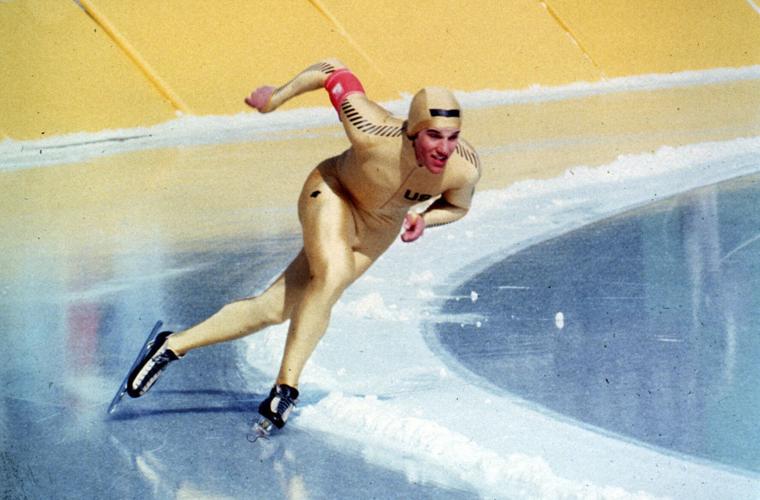
Eric Heiden is Madison's most decorated Olympian. At the 1980 Winter Games in Lake Placid, New York, he won five gold medals in speedskating, becoming the first person ever to win that many medals at a single Winter Games. He set four Olympic records and one world record.
Heiden, who grew up in Shorewood Hills, is now an orthopedic surgeon, opening a practice with his wife, Dr. Karen Heiden, in Utah. He remembers the homecoming celebration at Camp Randall, with over 30,000 people cheering.
“There's nobody like the people from your own hometown. Today has been really special,” Heiden told the State Journal in 1980.
At the same Games, a handful of speedskaters, all with the Madison Speed Skating Club, represented the city. Heiden’s sister Beth won a bronze in the 3,000 meters, and the two were not the only siblings: sisters Mary Docter and Sarah Docter Williams also went to Lake Placid, along with Dan Immerfall (who won a bronze in the 500 meters in the 1976 games) and Peter Mueller (gold in the 1,000 meters in ‘76).
“They put on a big reception for myself, for Beth, Mark Johnson — we had a lot of good Olympians in 1980,” Heiden said.
As a kid, Heiden skated at Tenney and Vilas parks, “where they were very good about maintaining the ice.” He came to prominence during arguably Madison's heyday of speedskating.
For Heiden, “what made Madison a hotbed for speedskating was the group ... (we) had a lot of skaters from outside of Madison who would come and spend the summers in Madison because of the training group that was there.”
He highlighted Dianne Holum, who won four medals at the 1968 and 1972 Olympics before retiring at 20.

During the 1980 Winter Games in Lake Placid, speedskater Eric Heiden of Shorewood Hills won gold in every event in which competed. The U.S. won six gold medals at those Games: Heiden won five, and the U.S. men's hockey team featuring Badger players Mark Johnson and Bob Suter won the other.
“She came to Madison to … get a degree in education, and she started coaching the team, and we started to be successful,” Heiden said.
Heiden’s success has inspired other local speedskaters, like Casey FitzRandolph from Verona, who skated with the Madison Speed Skating Club and won the gold in the 500 meters at the 2002 Salt Lake City Games. The last American man to win gold in that event was Heiden.
“I was playing hockey back in 1980 when Eric won his golds, and apparently he impressed me more than our men's hockey team did because I hung up my hockey skates,” FitzRandolph told the New York Times in 2002.
Heiden has his eye on Jordan Stolz, a speedskater who was born in West Bend, north of Milwaukee. Stolz has been compared to Heiden and is favored to win four golds in Milan Cortina.
“He is one of those sort of once‑in‑a‑generation skaters. And I think if you are interested in watching the Olympics and seeing some good athletes in their prime, make sure you’ve got your TV turned to speedskating when Jordan is skating. Stolz will compete in the 500, 1,000, 1,500 meter races and the mass start events. His first race, the 1,000 meters, is on Feb. 11.
“I think he’s going to show the world that he is an Olympic champion,” Heiden said. “Plus he’s a good guy – just a nice Midwestern Wisconsin kid.”


