
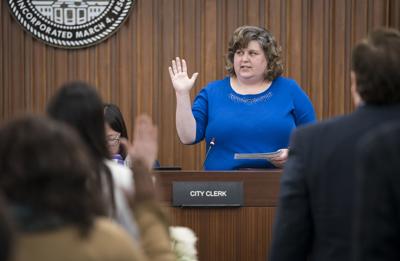

The Wisconsin Elections Commission will investigate not just how Madison failed to count nearly 200 absentee ballots from the November election but specifically the actions of City Clerk Maribeth Witzel-Behl, who notified the state about the error over a month after missing votes were discovered.
The commission voted unanimously during a special meeting Thursday to begin the bipartisan investigation into the city clerk’s office and whether “Witzel-Behl has failed to comply with the law or abused her discretion regarding the 193 uncounted absentee ballots.”
Although the Elections Commission confirmed that the voters’ choices on the 193 ballots were not enough to alter any election outcomes, commission Chair Ann Jacobs called the incident egregious and said the city’s response lacked the transparency she has experienced with other mishaps.
“When we've had other mistakes made by municipalities, we knew about it within minutes of it happening, of them figuring out what happened. We were in the loop,” Jacobs said.
“We were able to work with them to figure out the solution. We figured out what the problem was; we put it in our canvas so that when we canvassed at the state level, we were able to incorporate that.”
After being directed to do so by the mayor’s office, the Madison city clerk’s office first informed the public on Dec. 26 about the unprocessed absentee ballots from three wards near downtown and the University of Wisconsin-Madison campus on the west side. That was six weeks after the first batch of 68 ballots was found in a tabulator machine, sealed in an envelope that was inside a sealed courier bag.
That machine came from the polling site at Madison West High School and involved 67 absentee ballots for ward 65 and one mis-sorted ballot for ward 68.
The clerk’s office learned of the second batch of 125 uncounted absentee ballots on Dec. 3, in a sealed courier bag that came from the polling site at the Nicholas Recreation Center. The error meant that 24% of all absentee voters in ward 56 did not officially participate in the election, even though they returned their ballots properly.
The Cap Times was unable to reach Witzel-Behl on Thursday for comment.
Witzel-Behl’s office first notified the state about the two discoveries on Dec. 18, in an email asking for help “with entering and recording the uncounted ballots in the statewide voter registration system,” according to an Elections Commission memo.
City Attorney Michael Haas didn’t learn about the uncounted votes until the next day on Dec. 19, and Mayor Satya Rhodes-Conway was first notified Dec. 20, according to a timeline from the mayor’s office.
Rhodes-Conway issued a statement Thursday offering full cooperation with the investigation and adding that the city’s own review would not hinder the state’s probe.
“As I have stated, this oversight, and the time it took to bring it to the attention of other city officials and the Wisconsin Election Commission is a significant departure from the high standard our residents expect and must be addressed and avoided in future elections,” the mayor said.
“I agree with the Wisconsin Election Commission staff memorandum which states that an investigation can help provide transparency and accountability, as well as hopefully provide lessons that all Wisconsin clerks can learn to prevent similar errors in the future."
This is the first time the commission has used this investigation authority since the panel was formed over eight years ago in place of the former Government Accountability Board.
Elections commissioners discussed whether they should wait for a complaint to be filed but chose to proceed with an immediate investigation, instead of risking that a similar error would happen in the February primary election.
Jacobs noted that a primary election outcome could be determined by a few hundred votes, emphasizing the need for a thorough examination. The urgency in addressing Madison’s ballot error is to get ahead of potential challenges and offer concrete solutions, she said.
“We can't be a part of the solution until we know what went wrong, and unfortunately, we just don't right now,” Jacobs added.
Angela O’Brien Sharpe, staff attorney at the Wisconsin Elections Commission, said that “the purpose of the investigation would be to create a complete record of what transpired so that the city of Madison can implement improved policies, and so that all Wisconsin clerks can benefit from understanding how to avoid similar issues in the future.”
It’s unclear what remedies the commission can order the city of Madison to implement as the result of its investigation, or whether it can discipline Witzel-Behl. The city clerk’s office and Rhodes-Conway previously said Madison already is working to put new procedures in place to prevent such an error in the future.
Note: This article has been updated to remove an error added during editing about the Madison city clerk position.